Let’s be honest for a second. When the word feminism drops into a casual chat among a group of guys, the room shifts. Someone will inevitably cross their arms, roll their eyes, or defensively say, “Bro, I respect women, but...”
We’ve all seen it happen. As a woman observing the modern Indian landscape, trying to talk about gender equality can feel like navigating a minefield of fragile egos, social conditioning, and deeply entrenched habits. So it begs the question: What does feminism from a man's perspective actually look like in our country today? And more importantly, why should men support feminism in India?
For the longest time, many men grew up with a very flawed idea of what the movement actually is. Take Pranav, a 26-year-old communications professional featured in research on Indian men and gender justice. He admitted that it had been a “very long and bumpy ride” for him because he initially grew up believing that feminism was simply “the idea that women are superior” (Roy, 2018).
Many men are also fed the narrative that advocating for women means tearing other men down. But feminism is about equality, not female superiority. Its true meaning is simple: it asks for equal rights, equal respect, and equal opportunities for everyone, regardless of gender (Youth Ki Awaaz, 2025). It is not about hating men; it is about fixing a system that benefits only men.
Yet, online spaces and dating experiments show a different side of daily reality. If you read through the screenshots of Evelyn F’s conversations with men on Tinder, one thing becomes clear: many men do not understand feminism as a concept, do not like the word, and dislike being roped into conversations surrounding the subject (HuffPost India, 2015).
Why do average Indian men steer clear of conversations about feminism? Because challenging patriarchy means giving up comfort. It means asking men to listen more, share responsibilities, and let go of certain unearned privileges. To the uninitiated, doing all of that can feel extremely uncomfortable.
While it is easy for men to say they support gender equality in India, standing up for it in practice can be a deeply isolating experience. Responding to a Reddit thread asking why men who believe in feminism fail to speak up around other men, a user named General-Elephant4970 shared a raw confession that many relate to privately:
“Because I’m a coward. That is the truth. So I have to gather a lot of courage to do that. There is fear of getting removed from the group or even violence. So I only pick up a fight or take a stand when I’m sure the other person would listen. Or at least not hurt me. Or if the woman is someone I really care about.”
His words hit on an uncomfortable truth: for many men, remaining silent about gender equality in the presence of other men is a calculated decision to avoid harassment from their peers. That fear of social ostracization, broken male bonds, or even physical retaliation from friends is very real. It shows how men exert quiet but formidable pressure on one another to maintain the status quo.
But why does this happen?
It is because India, as a country, has massive contradictions baked into its culture. On one hand, we celebrate powerful female political figures like Indira Gandhi, Jayalalithaa, and Mamata Banerjee. Indeed, Pew Research Center data shows that most Indian adults agree men and women make equally good political leaders. But on the other hand, nearly nine in ten Indians (87%) agree with the notion that “a wife must always obey her husband.” Furthermore, 80% agree that when jobs are scarce, men should have more right to employment than women, coupled with a 94% societal preference for having at least one son. These attitudes are not born overnight; they are the product of lifelong social conditioning.
Interdisciplinary researcher As’ad Shah points out in his work on masculinity studies, even men who enroll in academic programs like Women’s Studies face mockery and toxic assumptions. Male peers dismiss it as a “girly course” or a trick to improve their love life.
Shah also highlights a crucial truth about patriarchy: it hurts men, too. The hyper-masculine ideal that perpetuates violence against women also fuels communal tension, toxic peer pressure, and an environment where men are forced into a rigid, suffocating box.
Why should men care?
So, why should men care? Why should gender equality matter in Indian society?
The answer is simple.
When women have equal rights and responsibilities, everyone benefits from it. When we push for women's freedom and participation in the workforce, it lifts the entire economy. When a woman's mobility is not restricted, she becomes an active consumer. Her money supports local businesses, driving market demand in ways that strengthen the broader ecosystem.
When women actively participate in society instead of remaining passive bystanders, they become true equals. An equal partner or friend can shoulder life's burdens alongside men, freeing men to pursue aspirations beyond simply being a breadwinner.
Ultimately, a man's role in promoting gender equality is not about playing the savior; it is about standing shoulder to shoulder. Whether it means changing gender norms at home, calling out casual male chauvinism among friends, or actively fighting gender-based discrimination in the workplace, every small action counts.
Men do not need to be textbook experts or gender studies professors to start making a difference. So, how can men contribute to gender equality? Just listen.
As Pranav from the SAGE study noted after facing heavy criticism in feminist circles: “The best thing I can do is to listen and try to understand what they are saying.” Because men have lived so much of their lives blind to their own privilege, it is easy to make mistakes without realizing it. But the quest to achieve true and lasting gender equality in our country is not a sprint; it's a marathon. Everyone has to choose to show up every day and make a real effort. There’s no other way.
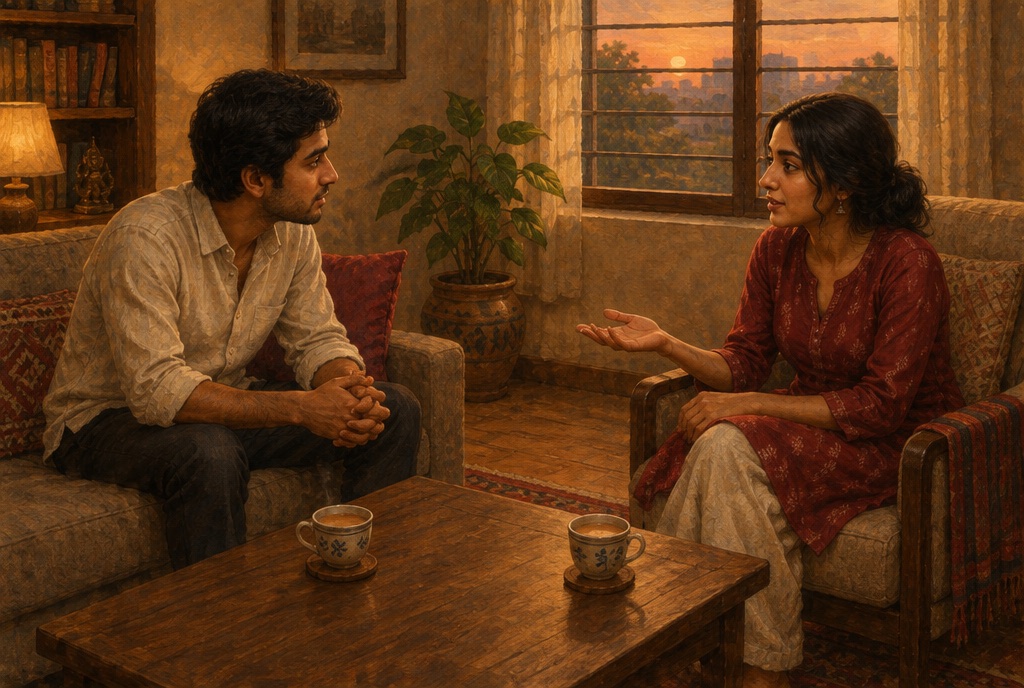
Cover: illustration generated with AI for Feministaa.
References
- Evans, J. (2022, March 2). Key findings on Indian attitudes toward gender roles. Pew Research Center. https://www.pewresearch.org/short-reads/2022/03/02/key-findings-on-indian-attitudes-toward-gender-roles/
- F, E. (2014, December 19). I asked Indian men on Tinder about feminism. Here is what they said... HuffPost. https://www.huffpost.com/archive/in/entry/i-asked-indian-men-on-tin_1_b_6346794
- Gilbertson, A. (2018). Of Mindsets and Men. Men and Masculinities, 23(2). https://doi.org/10.1177/1097184x18755493
- Kar, S. L. (2025, July 21). Do Indian men really understand feminism? Youth Ki Awaaz. https://www.youthkiawaaz.com/2025/07/do-indian-men-really-under-feminism/
- Shah, A. (2020, October 12). Navigating privileges as a male feminist within the Indian feminist movement. Feminism in India. https://feminisminindia.com/2020/10/13/privileges-male-feminist-in-solidarity-indian-feminist-movement/
Tagged
- Feminism
- Gender Equality
- Indian Men
- Masculinity
- Patriarchy
- Male Allies
- Feministaa Opeds