Durga Resides in the Land of the (Im)Pure
Clarin George · 22 September 2026 · 9 min read
This essay was first published on 13 November 2015 and was rewritten and expanded by Clarin George in September 2026.
Autumn has arrived.
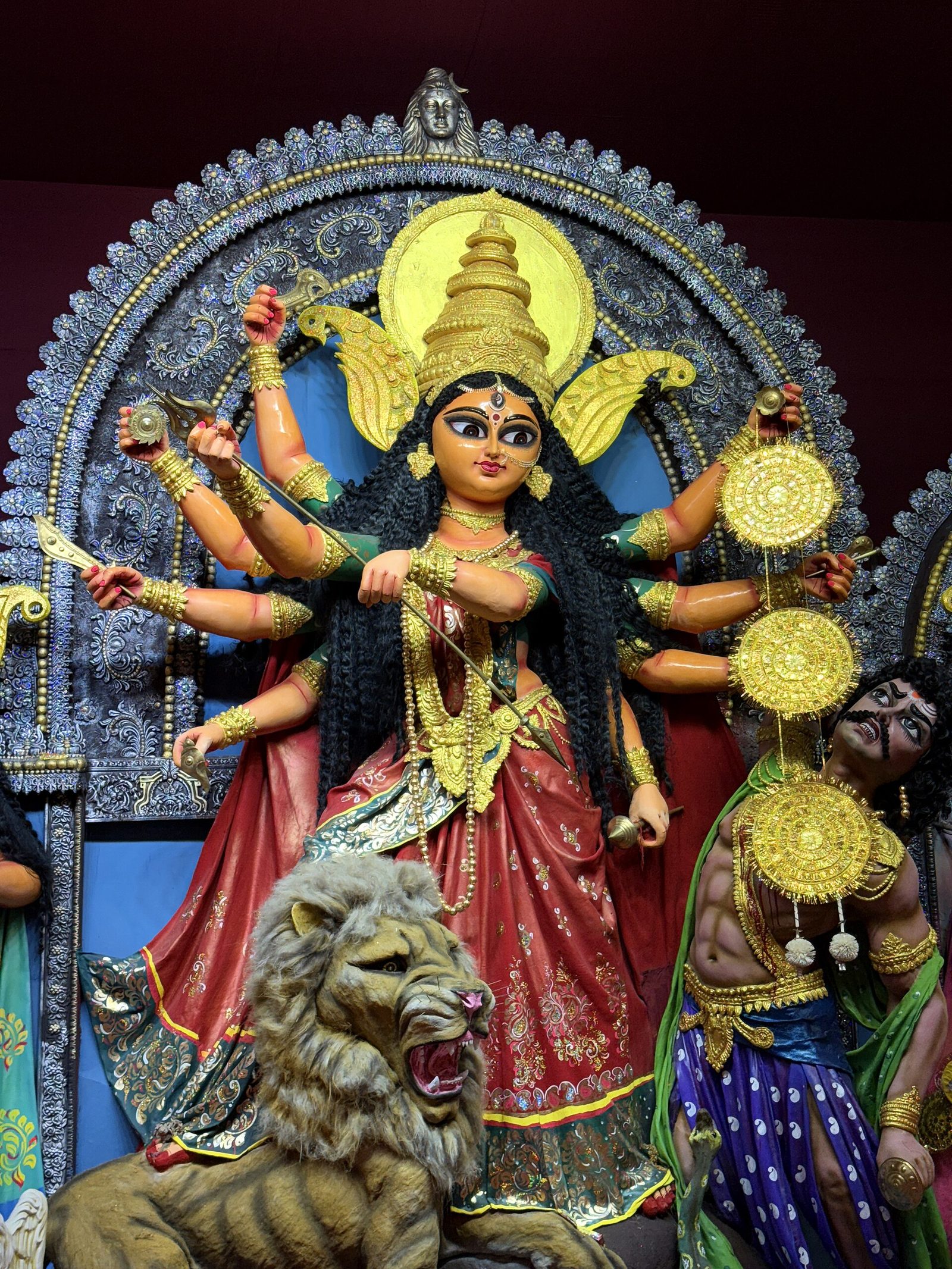
Every year, in the months of September and October, the large majority of people from Eastern and Northeastern India celebrate Durga Puja. Across West Bengal, Assam, Tripura, Odisha and Bihar, people set up pandals to offer their prayers to the goddess. Adorned in bright colored sarees, wearing beautiful ornaments, she sits on a pedestal. Devotees from far and wide come to visit her and receive her blessings. The idea of bowing down in devotion at the feet of a divine feminine power is somewhat at odds with how India treats femininity. Domestic cruelty, dowry deaths, sexual assaults are all part of the lived reality of Indian women. However, our country has great reverence for our goddesses who possess feminine virtues. Goddess Durga, for one, has earned every bit of the reverence she receives. She did something no man could ever do—kill a tyrannical, violent Asura.
In the lore, when the universe faced total destruction and the gods’ invincibility was challenged, only a woman could save the day.
Mahishasura, a shapeshifting buffalo demon, gained a boon from Lord Brahma: No man or god could defeat him. Emboldened with this boon he soon conquered the heavens and drove all the gods out of their abode.
Unable to slay him, Brahma, Vishnu, and Shiva pooled their divine energies together which created Shakti. From their powers came Goddess Durga. She was equipped with Shiva’s trident, Vishnu’s discus, a conch, a sword, a bow and arrow, a lotus flower, Indra’s thunderbolt, a gada, a spear and a snake.
When Durga challenged Mahishasura, a fierce ten-day battle ensued. Mahishasura continuously shifted forms, taking the shapes of an elephant, a lion, and a warrior. Finally, as he transformed back into a buffalo, Durga pinned him with her foot and pierced his chest with her trident, slaying the demon.
A goddess, a feminine power, slaying a demon no man can defeat is the part of the story that we celebrate every autumn. Isn’t it beautiful how gods pooling their power together created a woman and not a stronger man? Goddess Durga is the embodiment of all the best things each God has. What, then, does the mighty Goddess Durga do when she is not slaying demons? Ancient texts associate her with wilderness, vegetation, rugged mountains and wild habitats. She is described as living in these hard-to-live places looking out for forest dwellers and travelers traversing perilous paths. She is also the main deity of countless communities who lived on the fringes of the society. Like the sex workers of our country. Prostitutes, in fact, are quite crucial to the celebration of Durga Puja.
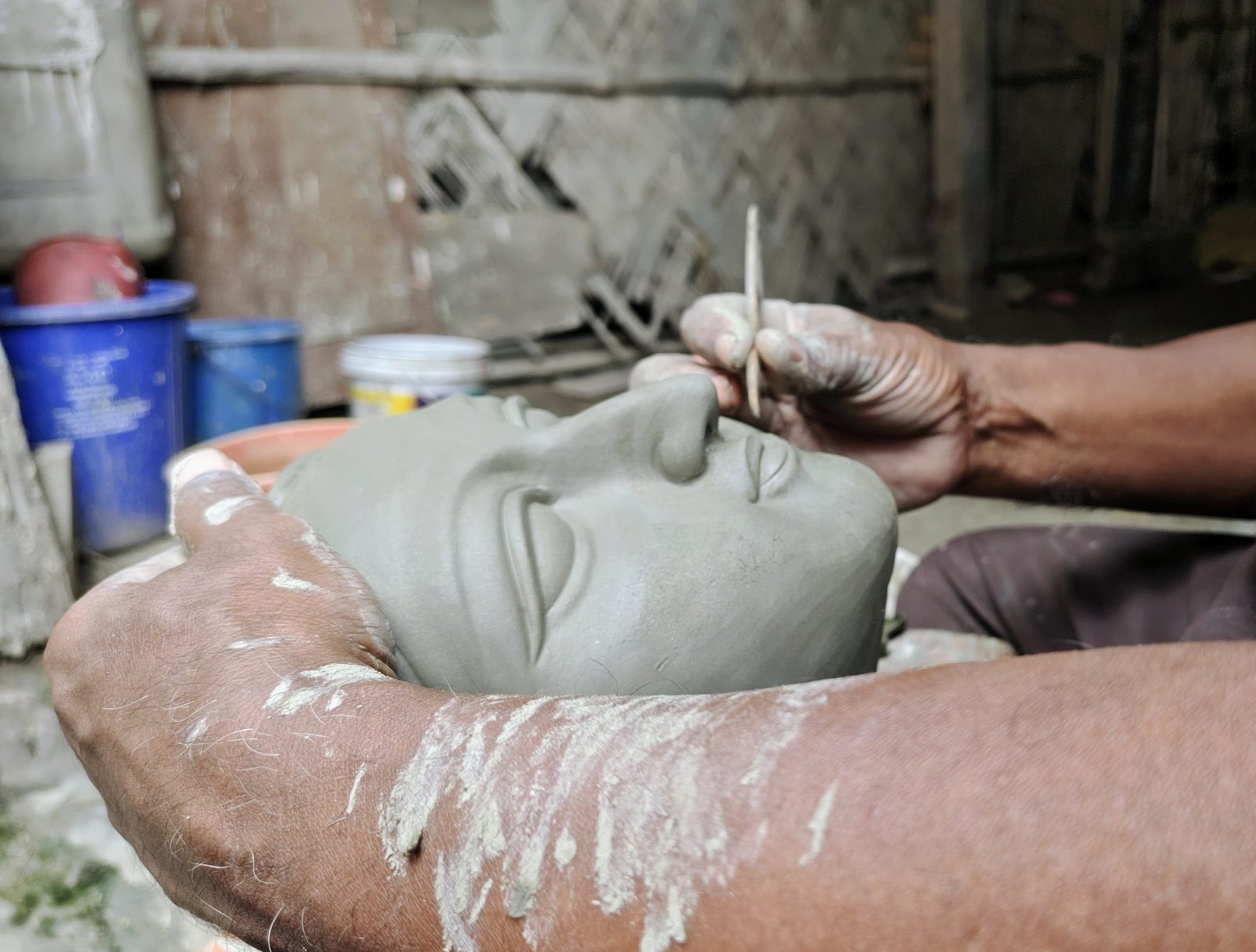
There was a custom in Bengali rural society which laid down the rule that the making of the image of the goddess Durga could not be perfect unless it was made from the clay collected from the earth of a prostitute's door steps. The peculiar logic behind this was the belief that the earth on the threshold leading to a prostitute's house was the purest since it contained all the accumulated virtues which were shed and left behind there by every man who lost them once he entered a prostitute's room! By turning her into an appendage to religious rites, and ingenious rural society made a religious virtue of a social necessity. (Mughals, Monsters and the Goddess in Bengal, 2013)
“Social necessity”. That is a perfectly apt way of describing sex work. There are lots of necessary professions out there where women have to utilize their bodies, or at least parts of their bodies. Surrogates, wet nurses, physiotherapists, nurses and nannies all use their bodies to offer necessary services which people benefit from. But India very conveniently degrades sex workers and their labour.
Why is that?
When British colonizers destabilized the Indian economy, many communities which had been working “respectable” trades for several generations, such as performers and artisans, lost their livelihood. Unemployed and starving, people from these communities had no other choice but to send their women to British military barracks to service the men. The resulting shame and loss of dignity deeply affected the collective cultural consciousness of our country. India, which once taxed prostitutes because of the legitimacy and utility of their work, started to shun and marginalize women who engaged in sex work.
Over the years, several legislative acts have been passed to ensure that women and children are not exploited in the flesh trade. In 1956, SITA (Suppression of Immoral Traffic Act) was passed, the main focus of which was to prevent trafficking and commercial sexual exploitation of women and girls. This act was later amended to ITPA (Immoral Traffic Prevention Act) in 1986. Under ITPA, it is perfectly legal for women to do sex work in exchange for money. This law only targets and penalizes other people (such as pimps, brothel owners, family members) from making money off of prostitution. Prima facie, ITPA seems like a well-designed, carefully drafted law that criminalizes only third parties. But in practice, ITPA is often used to make sex work difficult for the sex worker.
Under Section 15 of ITPA, the police have boundless authority to raid brothels without a warrant. These raids are meant to be conducted to search and apprehend sex traffickers. However, more often than not women get arrested for charges of solicitation. According to Kotiswaran (2008), in large raids, the number of women arrested is roughly four times more than the number of men. Moreover, under section 20 of ITPA, a Magistrate can remove a sex worker from any premises within his jurisdiction if he deems it necessary. However, the client who pays for sex work is not punished. While it is legal to engage in sex work, women can get arrested and harassed on charges like public solicitation. If engaging in sex work is legal for women, then why are they continuously harassed by the police and the judicial system? The answer is simple.
Brothel owners have a certain immunity against getting charged under ITPA because they collude with politicians and local police officers. There is rampant corruption within the system. Politicians view red-light areas as vote banks and brothel managers have quite an influence over sex workers and their communities. This, in turn, can help them secure block votes during elections. It also goes without saying that turning a blind eye to illegal operations can help politicians get sexual services for free or at a heavily subsidized rate under discreet arrangements. Moreover, what makes charging traffickers under ITPA incredibly difficult is the fact that getting a conviction requires a ton of evidence which can be very difficult to gather. It is far easier to arrest disenfranchised sex workers who have no political connections to tide them over. Occasionally, other players with their own agendas can step in and make their lives difficult too.
In 2003 the Surat police were allegedly responsible for arbitrary searches, arrests, physical abuse and the harassment of fifteen hundred sex workers in the Chakla Bazaar red light area. They also intimidated landlords into terminating leases with sex workers, leading to their forcible evictions [...] [P]rior to the eviction the state had offered sex workers a rehabilitation package of 35,000 rupees along with an offer to negotiate the release of sex workers’ deposits from landlords and accompany non-native sex workers home under full police protection. Yet not a single sex worker accepted this proposal. They demanded 200,000 rupees each and viewed police action against them as instigated by builders keen to develop a commercial complex. (Sword or Shield, 2013)
It is as plain as day to see that they were forced out of the land where they worked because someone could afford to pay the police and the judicial system to get a ruling in their favour. The police had violated Articles 14 (Right to Equality before law), 19 (Right to Freedom, including the freedom of movement and to practise any profession or trade) and 21 (Right to life and Personal Liberty which include the right to privacy and human dignity) of the Constitution in the process of evicting them. However, the Gujarat High Court saw nothing wrong with that. Not only did the sex workers lose that case, the court even rejected their claims to right to privacy.
The law enforcement and judicial systems treat sex workers with tremendous disdain, even though they are not committing any crime.
“We are not pickpocketing, we are not looting people, we are only selling our bodies to earn our living. How are the police and dadas living? If prostitution is stopped today 50% of the police income will also be stopped. If you go to the Special Court at 8 in the morning the judge even does not investigate the charges before pronouncing his sentence and asks us to pay a penalty of Rs. 50. Allow us to live and not die.” (Preparing for Civil Disobedience, 2001)
These words were uttered by a sex worker who was, in all likelihood, arrested for attending a conference held by an organization in Andhra Pradesh called Society for Awareness through Learning and Training (SALT). SALT, among other things, offers communities education on sexual health, safe sex, legal rights, vocational training for skill development and financial literacy. Leading up to the conference, the police had issued several warnings that any sex worker attending the conference would be arrested. The women were eventually arrested when they returned to their hometowns after attending the conference. Why did the police arrest sex workers attending a conference that gave them basic survival skills? The answer is again simple. They don’t want sex workers to become literate about their rights.
Women often go into sex work because they have children or other dependents who rely on them for sustenance. When other “normal”, “respectable” work fails to earn them a living wage, they have no choice but to monetize the one thing which they can negotiate the price of — their body. Sex workers often lack other monetizable skills and in some cases, they come from certain castes which over time have lost their traditional means of livelihood. Rehabilitation homes for sex workers don’t teach them anything marketable either. This is why sex workers attend conferences such as the one conducted by SALT. When sex workers learn life skills, and mobilize into unions that protect them from judicial exploitation, the police naturally target them. When sex workers gain knowledge, it poses a huge threat to police authority.
Sex work, like many other legitimate professions, generates profit and wealth for national economies and global industries. If sex work has value, should it not be compensated for adequately? If sex workers are important, should they not be legally protected from exploitation? What is the point of praying to Goddess Durga if we leave the women she would fight to protect in a state of abject destitution?
References
- Prabha Kotiswaran (2013) Sword or Shield?, Interventions: International Journal of Postcolonial Studies, 15:4, 530-548
- Prabha Kotiswaran, Preparing for Civil Disobedience: Indian Sex Workers and the Law, 21 B.C. Third World L.J. 161 (2001), http://lawdigitalcommons.bc.edu/twlj/vol21/iss2/1
- Arora, S. Women, Livelihoods, Sexual Morality and the Law: the Case of Bar Dance and Sex Work in India.
- KUMKUM CHATTERJEE Goddess encounters: Mughals, Monsters and the Goddess in Bengal. Modern Asian Studies, Available on CJO 2013 doi:10.1017/S0026749X13000073
- Banerjee, S. (1993). The “Beshya” and the “Babu”: Prostitute and Her Clientele in 19th Century Bengal. Economic and Political Weekly, 28(45), 2461–2472. http://www.jstor.org/stable/4400383
- Dhillon, A. (2019, May 16). ‘Like any other job’: Indian sex workers lobby for pensions and healthcare. The Guardian. https://www.theguardian.com/global-development/2019/may/16/like-any-other-job-indian-sex-workers-lobby-for-pensions-and-healthcare
- Rose, M. L. (2012, August 27). Red light city: Sex workers’ experiences of the city of joy. Madison Leigh Rose. https://madisonleighrose.wordpress.com/2012/08/27/red-light-city-sex-workers-experiences-of-the-city-of-joy/
Tagged
- Celebrity
- Content
- Entrepreneurial Interviews
- Entrepreneurs
- Feministaa Interviews
- Feministaa Media
- Indian Women
- Indian Women Achievers
- Inspiration
- Inspirational Content